James H. Maynard is a criminal defense attorney in Morristown who specializes in sex offense law. He is also a master falconer and general counsel for the North American Falconers Association (NAFA). His interest in the ancient pursuit of falconry was sparked when he was young, after reading an article in National Geographic about early falconers in the United States. From that moment, Maynard, who also grew up hunting, fishing and learning about wild edible plants, read and studied everything he could about falconry, and eventually became a master falconer.
He spoke recently about his interest in falconry and how those skills are sometimes used in the law. The conversation has been edited for
clarity and brevity.
What is falconry?
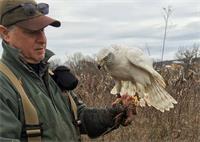
Falconry is the pursuit of wild game in its natural habitat by means of a trained raptor. Falconry is a hunting art, but it is important to note that it is the raptor, not the human, that is actually hunting. In falconry, the raptor is flying free, with no means of human control over their behavior. They are simply doing what they would do in nature—hunting for food. The falconer facilitates that process by bringing the raptor to the field and releasing it.
Nothing that the falconer does changes the basic equation between the raptor and the game that exists in nature. In fact, it is the evenly matched capabilities of the predator and the prey that makes falconry exciting: Many of the raptor’s attempts to catch the game are unsuccessful—and the falconer appreciates the successful escape of game, just as much as a successful capture of the game by the raptor.
Why are you fascinated with raptors?
I’m attracted to raptors because of their sheer beauty. However, it is the impressive capabilities of raptors that motivates my passion for the practice of falconry. Anyone who looks at a hawk or a falcon can immediately see the intensity of these impressive animals. The practice of falconry provides the privilege to interact with raptors in close proximity, and to observe their skills and their immense drive to succeed in survival. The combination of beauty, intensity and skill that are the essence of a raptor inspires my fascination for them, and my dedication to be with them in a close relationship.
You are a master falconer. What is that?
There are three levels of falconry license: apprentice, general and master. Each level requires a certain amount of time as a practicing falconer, and a documented level of skill and practice knowledge. Each level of falconry license has designated privileges, such as the type and number of raptors that may be possessed by the falconer.
As general counsel for the North American Falconers Association (NAFA), what kind of legal issues do you have to handle?
As general counsel for NAFA, a nonprofit corporation, I handle the corporate counsel functions of the organization—basically, the corporate governance of a tax-exempt entity. However, I also engage with members of the falconry community regarding various animal law and raptor-possession issues that arise based on their activities as falconers. In addition, I monitor and advise NAFA on matters related to state, national and international law and regulation regarding the possession and sustainable use of wildlife, and the conservation of raptor species.
NAFA’s website cautions would-be falconers to be aware that after investing a lot of time and effort in learning the sport their bird could choose to simply fly away and never return. Has this ever happened to you and, if so, how did you deal with it?
Fortunately, I have never lost a bird. I have had a couple of incidents where my bird decided that it wanted to stay out overnight, and I had to return to the field early the next morning to retrieve it.
Do you see a parallel between falconry and the practice of law, in that you can invest a lot of time and effort into a case, only to lose it?
Yes, there is a parallel—in the law, despite your greatest efforts, and all of your skill, you may lose a case that you desperately want to win. A lawyer accepts such outcomes as the will of the jury, or the determination of the judge. In falconry, it is the will of the hawk or falcon that has made the decision to return to the wild. In the law, I can appeal; in falconry, I can begin the search for a new bird. In both cases, I can be content if I know that I did my best.