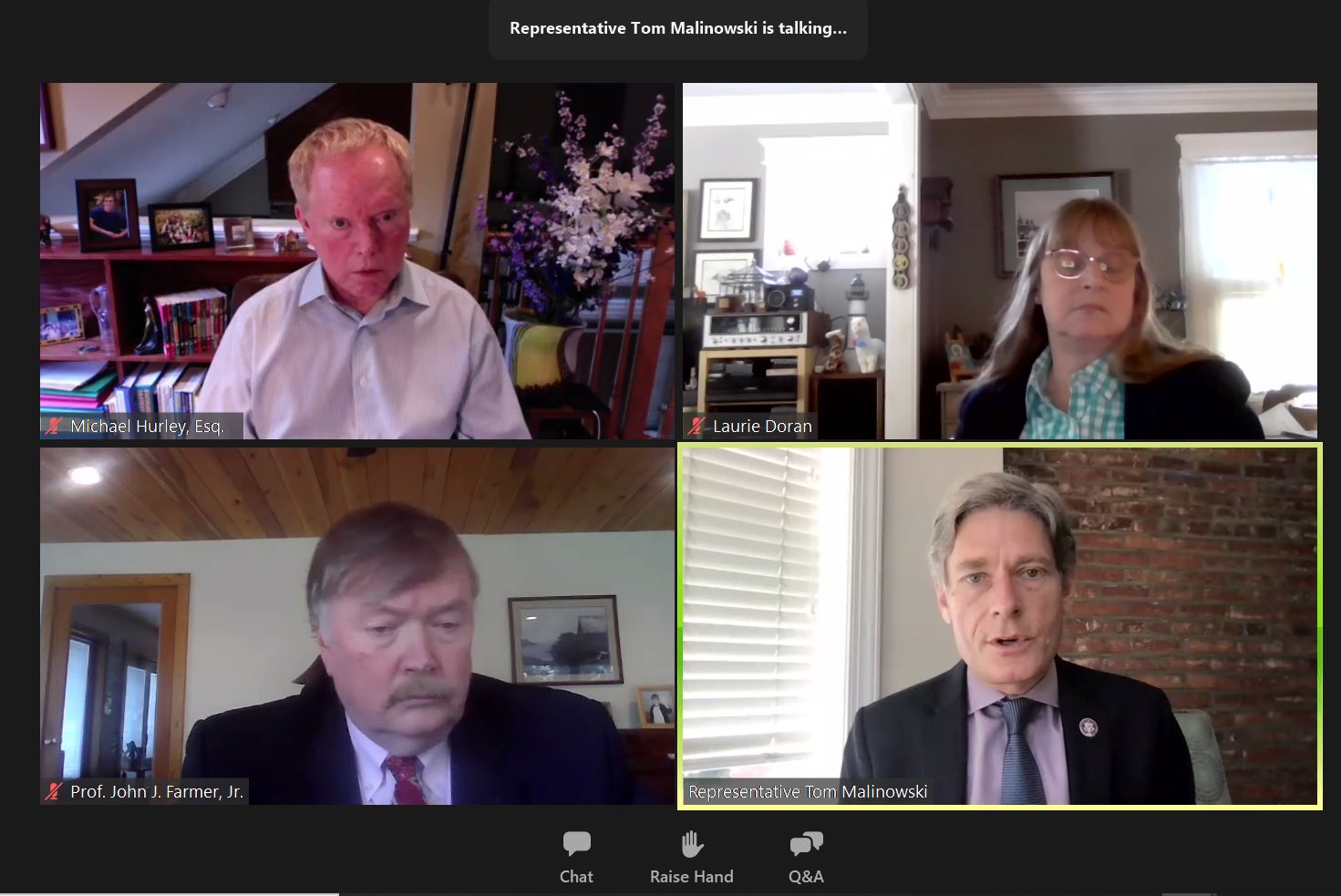
 A panel of security experts, scholars, and a U.S. Congressman sounded alarms about the growth of “home-grown hate,” particularly through the use of online forums and social media platforms, in an occasionally disturbing and information-packed panel at the NJSBA Virtual Annual Meeting on Thursday afternoon.
John J. Farmer Jr., executive director of the Rutgers University Eagleton Institute of Politics and director of the Miller Center for Community Protection and Resilience, organized the seminar, titled Home-Grown Hate: The Disturbing Truth about Hate Groups in New Jersey and How to Stop Them.
The panel featured an appearance by U.S. Congressman Tom Malinowski, who opened the session by reflecting on social media and its role in events like the violent Jan. 6th attack on the U.S. Capitol.
Companies like Facebook “follow every single thing we do online,” he said. “Every website we visit, everything we click on, how much time we spend on particular types of content. They then feed us that content that they believe will maximize our engagement on their platform.”
As a result, he said, people see less and less content that challenges their already held beliefs and biases. The result is the massive polarization that played a role in so many “otherwise ordinary” Americans doing something as radical as violently attacking the U.S. Capitol while believing their actions were completely normal, even patriotic.
But keeping people engaged through these algorithms is the “the central way in which these companies make money,” Malinowski said. That’s why he said he has introduced legislation that would remove immunity offered to online companies through section 230 of the Telecommunications and Decency Act “if it can be shown that you have recommended or amplified content that leads to certain forms of extreme harm in the real world.”
Subsequent speakers also talked about the country’s polarization and the harms that social media in particular present. Michael Hurley, a retired CIA case officer and former senior counsel to the 9/11 Commission, declared that we are now in the age of “secular terror.”
“I worry the we haven’t seen the climax yet,” he said. “We have to be ever-vigilant and try to be out in front of this.”
Laurie Doran, director of the Intelligence and Operations Division of New Jersey’s Office of Homeland Security and preparedness, urged the public to report suspicious behavior. She talked about how the state agency is successfully working with the federal government on intelligence and prevention, and steered the public towards the website of her agency, which includes everything from information on controlling rumors and disinformation on COVID-19 to a predictive threat analysis that assesses the actions or activities that an ideologically motivated individual or group will likely engage in.
Finally, Joel Finkelstein, a psychologist/neuroscientist who studies the rise of hate and incitement in online social platforms and director of the Network Contagion Research Institute, gave a presentation that mapped the proliferation of hate groups online tracking the code words the groups use — “a disease made out of hashtags,” he said.
Page after page of spider-web shaped graphics illustrated surges in online chatter ahead of events like the 2018 shooting on the Tree of Life Synagogue in Pittsburgh. The suspected shooter, Robert Gregory Bowers, is accused of killing 11 people and wounding six in the attack during Shabbat morning services.
Finkelstein described how memes on Twitter and other social networks radicalized individuals and has led to growth in anti-government and anti-institution extremist communities across the globe who perpetuate conspiracy theories that now include anti-vaccine and anti-restriction language.
All the panelists agreed that continued vigilance — against violence and misinformation — was crucial. Farmer noted, “Disinformation spreads four times faster than the truth.”